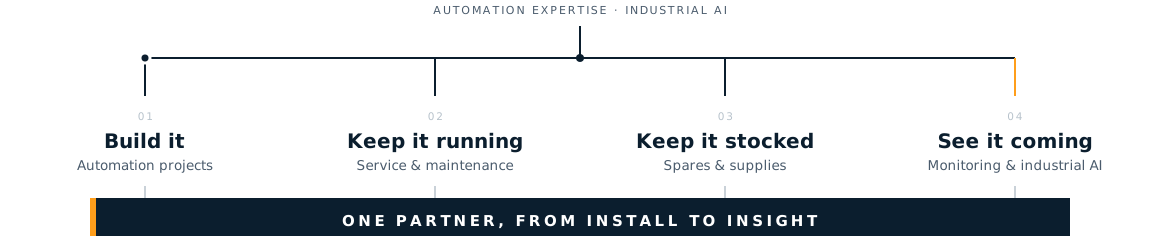
 Projects
 Service
 Supplies
 Monitoring
Automation projects
- PLC and DCS migrationObsolete controllers replaced against your shutdown window, with a rollback point and a spares bridge
- SCADA and HMI systemsLicensing, redundancy and screen hierarchy settled before anything is bought
- VFD retrofit and drive fleetsIncluding an honest check of whether the energy saving is actually there
- Control panels, MCCs and consolesFault level, clearance and heat load calculated at design, built in Bintulu
Service and maintenance
- Field service and breakdown supportSame-day for Bintulu and Samalaju, plus planned and retained arrangements
- Thermal and partial discharge surveyUnder load, graded to a published criterion, reported with an action
- Spares and obsolete partsIncluding the authenticity checks that actually verify something
Monitoring and industrial AI
- Five bridges between the plant and the modelRotating equipment, camera, energy, operations intelligence and the OT Navigator
- Condition monitoring and predictive maintenanceVibration, ultrasound and thermal, standalone, proven on one asset first
The predictive layer is the reason the automation work matters to us, but it is the last step, not the first. A model is only as good as the signal underneath it, and the signal comes off equipment that has to be instrumented, time-aligned and given operating context before anything is predicted. That layer is the part most monitoring skips, and it is the part that decides whether a system works on a real plant or only in a demonstration.
Which is why we will say plainly: if your controls are unreliable, fix the controls first. Analytics on top of a system nobody trusts produces confident answers to the wrong question.
How an engagement usually starts
- A conversation about the constraint, not the product. What stops, how often, what it costs when it does, and what you have already tried.
- A survey. What is actually installed, which drawings are current, and what state it is in. For a Sarawak site this is a visit, not a questionnaire.
- A written scope with the assumptions stated at the point they apply, so you can see which parts of the price are firm and which depend on something we could not confirm.
- A proposal you can compare against someone else's, because the scope is specific enough to make two quotations mean the same thing.
If the honest answer is that you do not need the work, or that somebody else is better placed to do it, we would rather say so at step one.
Questions we get asked
Do you only work on systems you installed?
No. Most of our service work is on other people's systems, and most projects begin with equipment installed by someone who is no longer involved.
Are you tied to one control system brand?
No. We work across the platforms our clients actually have, and the right migration target is decided by what the plant already runs, what its people are trained on, and what is supportable locally, not by which brand we happen to sell.
Can you do a small job?
Yes. A single drive, one panel modification, one survey. Small jobs are how most long relationships start, and they are also the fastest way for both sides to find out whether the working relationship is any good.
Do you subcontract the work?
Core engineering and commissioning are done by our own engineers. Specialist trades are brought in where a job needs them, and we tell you who is doing what rather than presenting a subcontracted scope as our own.